

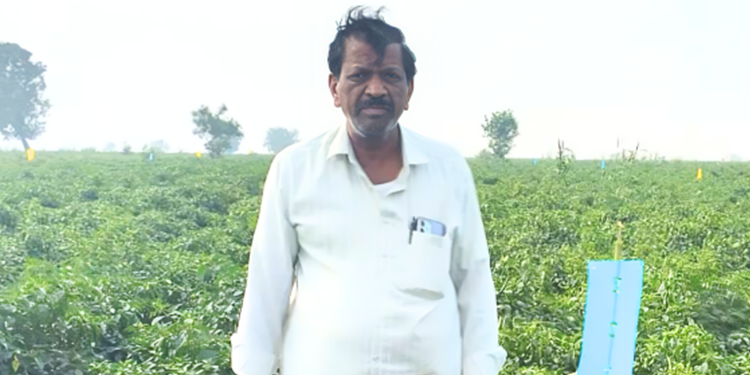
Malli Gouda, a farmer from Orvai village in Kurugodu taluk, Ballari District, had long relied on the practices of his neighbors to guide his crop protection decisions. If nearby farmers sprayed their chilli fields every two or three days, he would do the same, believing that frequent spraying was the safest way to protect his crop. Over time, this practice became routine. Sprays were applied not because his crop needed them, but because others were doing it. The result was rising input costs, excessive chemical use, and growing risks of pest resistance. Instead of improving crop health, this approach often led to inefficiency and wasted resources.
Malli’s farm reflected a common challenge in the region: decisions driven by peer pressure rather than scientific need. What he lacked was a systematic, evidence-based approach that could break this cycle and help him manage pests more effectively, while keeping costs under control.
Intervention
Under the project “Strengthening Sustainability of the Spices Value Chain through FPOs,” supported by CII Foundation and CII-FACE as knowledge partners, Orkla India as the donor, and Farmitopia as the technical partner, interventions were undertaken to help Malli Gouda move away from assumption-based spraying practices.
- The field officer began by explaining the role of sticky traps in pest management. Blue, yellow, and white traps were demonstrated as simple but powerful tools to monitor specific sucking pests. For the first time, Malli Gouda could see which pests were actually present in his field, rather than assuming based on what neighbors were doing. This gave him confidence to act only when necessary.
- In parallel, scientific scouting was carried out using the Cropmint+ platform, which provided systematic observations and data-driven recommendations. Instead of blanket advice, the platform ensured that sprays were suggested only when pest pressure crossed a threshold.
- To make adoption practical, Malli Gouda was given sample traps and hands-on training. He learned how to place them correctly, how many were needed per acre, and how to interpret what he saw on the traps. This combination of digital scouting and physical monitoring tools gave him a clear, evidence-based framework for decision-making.
Results
- The intervention marked a turning point. Malli Gouda shifted from guess-based spraying to a disciplined, observation-led crop protection strategy. He began to understand that the right input should be used at the right time - and only when crop conditions demanded it.
- As a result, he reduced the number of sprays by 20–25%, which directly lowered his crop protection costs by 12%. More importantly, crop health improved because inputs were applied more precisely, reducing chemical load and minimizing the risk of pest resistance.
- The difference was visible not only in his own field but also to his neighbors. His chilli crop looked healthier, and his expenses were lower compared to others who continued frequent spraying. This sparked curiosity among neighboring farmers, who started asking about traps and scientific scouting. The ripple effect created a 10–15% community-level adoption interest, showing how one farmer’s shift can influence broader behavior.
Benchmark vs Endline
| Parameter | Assumption (Without Intervention) | Endline (With Intervention) | Impact (in %) |
| Spray Practice | Frequent sprays every 2–3 days | Sprays only when required | ~20–25% fewer sprays |
| Pest Management | Reactive pest control | Scientific scouting & traps | Timely, accurate control |
| Input Cost | High due to repeated sprays | Reduced by 12% | 12% cost savings |
| Crop Health | Mixed, risk of resistance | Improved crop health | Noticeable improvement |
| Farmer Behaviour | Depended on neighbours | Evidence-based decisions | Behavioural change achieved |
| Community Influence | No influence | Neighbours adopting traps | ~10–15% adoption interest |
Conclusion
Malli Gouda’s case demonstrates how timely intervention and practical field guidance can transform farmer behavior. By adopting sticky traps and scientific scouting, he reduced costs, improved crop health, and minimized unnecessary chemical use. The impact extended beyond his farm, influencing neighboring farmers and creating a positive cultural shift toward evidence-based farming in the community.