

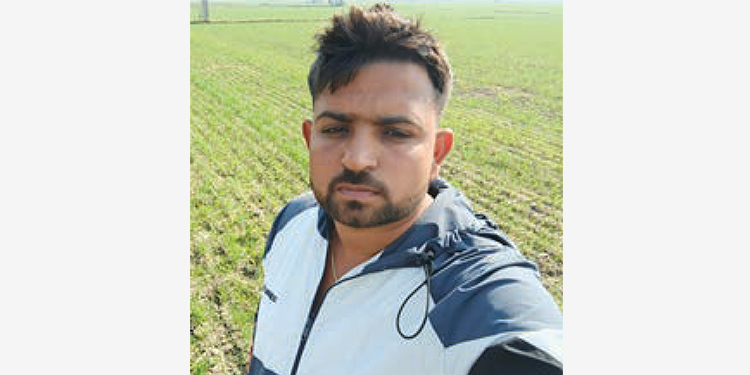
At just 27 years old, Mohit, a farmer from Bhurain village in Pillu Khera block, Jind district, has already faced numerous challenges in his agricultural journey. Farming since 2018, he cultivates vegetables, wheat, paddy, mustard, and bajra on his three-acre land. Like many others in his community, he struggled with crop residue management and initially resorted to burning stubble after every harvest. The practice, though common, had serious consequences— damaging soil health, increasing pollution, and adding unnecessary costs.
Before joining the Crop Residue Management (CRM) Project, Mohit faced multiple challenges. He lacked awareness of sustainable residue management practices and found modern farming equipment too expensive. With limited time between harvesting one crop and sowing the next, burning seemed like the easiest and fastest option. However, the environmental and health consequences were severe. Every year, he burned nearly 80% of his crop residue, contributing to air pollution and depleting his soil’s fertility.
Though Mohit was aware of government schemes for residue management, he never found them beneficial. However, when the CII Foundation introduced the CRM Project in his village, he noticed a difference.
Unlike previous programs, this initiative provided proper training, awareness, and easy access to advanced machinery. Seeing the opportunity to improve his farming practices and reduce costs, he decided to participate. In October 2024, he joined the project and implemented CRM techniques on 50% of his farmland as an experiment.
The results were remarkable. Mohit accessed machines from the Tool Bank, participated in training sessions, and adopted in-situ crop residue management. Earlier, he spent ₹2,500 per acre on burning stubble, but after switching to CRM methods, his costs dropped to ₹1,000 per acre. The use of modern machinery not only reduced expenses but also improved his soil health, leading to better crop yields.
Through the CII Foundation’s training programs, Mohit gained valuable technical knowledge about sustainable farming. He learned how to use equipment like the Happy Seeder, which allowed him to incorporate crop residue into the soil instead of burning it. This shift not only enhanced soil fertility but also contributed to a cleaner environment. Previously, he would burn around 2.5 to 4.77 tonnes of crop residue per acre each season. Now, by using CRM techniques, he has eliminated stubble burning entirely, significantly reducing air pollution in his village.
Beyond the environmental benefits, Mohit has also experienced positive changes in his personal life. The smoke from stubble burning used to cause health issues in his family and community. Since adopting sustainable practices, he has noticed an improvement in air quality and overall well-being. Additionally, his expenses have further reduced to ₹800-900 per acre, making farming more profitable and sustainable.
“This project has not only transformed my farming practices but also positively impacted the environment and the well-being of our community,” Mohit Shares. Mohit’s story highlights the power of awareness, accessibility, and community-driven initiatives in transforming agricultural practices. Through the support of Fidelity International and the CII Foundation, he has become a model for sustainable farming, demonstrating that with the right knowledge and resources, farmers can achieve both economic and environmental benefits.