

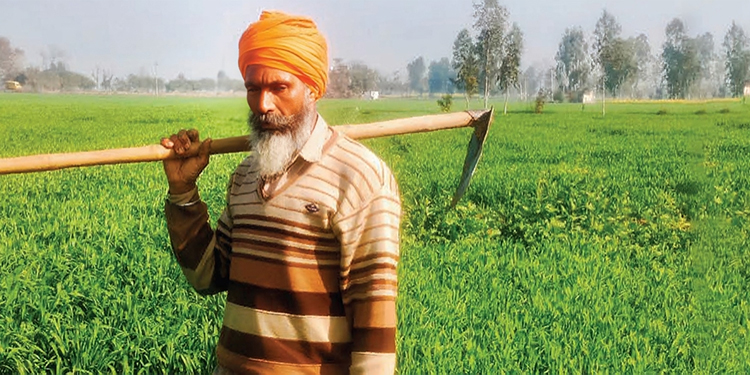
Pyara Singh owns 5 acres of agricultural land. Like several other farmers, he followed the traditional method of managing crop residue: he burnt it. Even though he had tried non-burning methods of managing crop residue, he found the method too costly since he had to rent out machines at an unaffordable cost. Moreover, he was unaware of the magnitude of the damage stubble burning caused to the soil and environment.
Pyara Singh saw awareness vans with loudspeakers informing farmers about crop residue management running through his village. He became curious about the alternative ways to manage stubble. A meeting with the Sarpanch and volunteers of the crop residue management project, Vayu Amrit, made Pyara Singh aware of the enormous damage to the soil due to crop residue burning. “I discovered that burning affects the environment and leads to air pollution as well as makes the soil infertile” he says. He also learnt about viable alternatives to stubble burning offered through Project Vayu Amrit. Volunteers visited his home to dispel any doubts he had and give him more details. “Project Vayu Amrit was providing machinery at an affordable rate.” Pyara Singh also attended the field demonstrations to understand how the machines could be used optimally. Convinced, he associated with the project and used a Super Seeder and says “I find using this conservational method simple. In the method, straw mixed in the land works as a fertilizer, reduces the quantity of the weed, and reduced the cost of sowing crops.” Now farmer Pyara Singh does not burn stubble. He has been using Super Seeder and is happy with the results.