

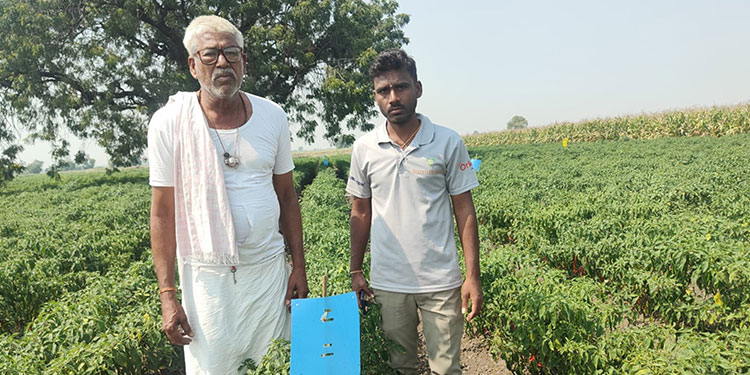
M. Hanumanthappa Reddy, a progressive farmer from Kalkamba village in Ballari, cultivates red chilli (HPH 5531) on 4.5 acres. Like many farmers in the region, he also faced severe challenges in managing sucking pests such as thrips and mites. These pests caused leaf curling, inhibited photosynthesis, stunted crop growth, and led to lower yields. Consequently, nearly 40% of his cultivation costs were spent on chemical pesticides; however, effective control remained inconsistent, leading to rising expenses and environmental concerns.
Intervention
Under the project "Strengthening Sustainability of the Spices Value Chain through FPOs”, the CII Foundation supported by Orkla India Ltd., introduced an Integrated Pest Management (IPM) approach:
- Promotion of Sticky Traps: Introduction of yellow, blue, and white sticky traps for monitoring and controlling sucking pests.
- Capacity Building: Implementation of training programs and field demonstrations regarding the correct placement, density, and usage of these traps.
- Reduced Chemical Dependency: An emphasis on behavioral changes of shifting from heavy pesticide use towards eco-friendly, preventive practices.
Results - Widespread Adoption: Successful deployment of sticky traps across the entire farm.
- Targeted Control: Yellow traps effectively targeted aphids and whiteflies, while blue traps managed thrips.
- Early Detection: Regular monitoring enabled timely, need-based action rather than broad-spectrum spraying.
- Chemical Reduction: A reduction of 2-3 chemical sprays for thrips, mites, and other sucking pests.
- Cost Efficiency: A significant decrease in expenditure on plant protection chemicals.
- Sustainability: Lower chemical usage contributed to a safer and more environment-friendly farming system.
Benchmark vs Endline
| Parameter | Before Intervention | After Intervention | Impact |
| Pest Management | Heavy reliance on chemical pesticides | Sticky traps + targeted action | Reduced sprays, better control |
| Cost of Cultivation | 40% spent on pesticides | Reduced pesticide expenditure | Cost savings |
| Crop Health | Leaf curling, poor growth | Improved growth, healthier plants | Better productivity |
| Environmental Impact | High chemical load | Eco-friendly practices | Safer farming system |
Conclusion
By adopting sticky traps and IPM practices, Hanumanthappa Reddy reduced his operational costs, improved crop health, and minimized his environmental footprint. This case demonstrates how sustainable pest management, supported by Farmer Producer Organizations (FPOs), empowers farmers to achieve profitability while protecting the environment.